The pros and cons of the culture of volunteerism in Namibia

I was stunned to see that it’s been more than a year since I wrote a post on this site. Well, family issues did play a role in this lack of activity, as did a nagging awareness that social media is responsible for a catastrophic contribution towards global carbon emissions through its profligate use of electricity generated by fossil fuels. I am not a doom-and-gloomer when it comes to the many productive applications of social media – I am certainly an avid consumer myself, albeit (I hope) a discerning one – but I do try to rein in my use of it, and limit how many posts, stories and updates I contribute on various platforms.

(It’s also not escaped my notice, of course, that WordPress promotes the use of AI technology for the creation of images etc…Down with this sort of thing! as they say on Craggy Island!)

However, the chief reason for a lack of webpage activity has been the fact that, perhaps more than at any other time in my life, I have been BUSY in ways I could not have foreseen this time last year. I continue to joyfully manage the Sew Good Namibia project on a voluntary basis, responsible for marketing and logistics while our four craftswomen create their wonderful designs (currently sold at 12 outlets around the country) to support their families. I’m also still writing the short stories that are regularly published in online journals and magazines – a second collection of which will soon appear in print (as The Limbo Circus) through the marvelous Modjaji Books.

However the principal reason why my days are filled with bustle and hustle is the incredible growth of the Promising Pages Pilot Initiative (PPPI) that was launched early last year. I have been overwhelmed by the success of the pilot phase since we kicked off with a few requests for book donations and suggestions for sites where we could put up suitable receptacles where ordinary Namibians could ‘Take a book. Read a book. Return a book’. As always, identifying dynamic individuals who understand a hypothetical idea and want to see it flourish as a practical enterprise entails expending a GREAT deal of time and effort with others who turn out to be time-wasters in the end (regrettable, but true). And, as I discovered with ‘Sew Good Namibia‘, it’s critical to let a project develop organically in its own time, and in its own way, rather than imposing inflexible and unrealistic expectations on an untried concept.

In addition, each and every one of the thousands of books, pamphlets, journals, study guides, and magazines that have been given to the PPPI to date have to be assessed for suitability (older, pre-Independence materials, especially, will not pass muster in these more enlightened times and have been donated to the Katutura Community Art Centre for use in installations and other artworks). Then these have to be categorised according to language, age of the readership, and genre before being packed up ready for distribution.

At the time of writing we now have little library installations in disadvantaged communities in Okahandja and Hakahana, with others scheduled soon for the Physically Active Youth and Mammadu Trust premises in Katutura, Windhoek. The University of Namibia Main Campus also has two large bookshelves in place and regularly replenished with a wide range of fiction, textbooks, non-fiction and Africana. It was amazing to see how many faculty and students turned up for the official launch in March, racing to select some reading matter to borrow the minute the ribbon was cut on the shelving. More little libraries will be established at Groot Aub and Rehoboth, to the south of Windhoek, in the near future and plans for further expansion are in the works.

All this requires a great deal of time, effort, admin, petrol and schlepping, 7 days a week, which I am thrilled to have the hours and energy to still contribute right now. I’ve also expanded my circle of friends as generous donors and enthusiastic community members embrace the PPPI idea and help it to expand. An additional gift.

Promising Pages Pilot Initiative (PPPI) poster created in four languages widely used by Namibians

BUT. Namibia has a huge cohort of keen, articulate, educated and media-savvy young people currently looking for work. Our youth unemployment rate is almost 3 times the global average. It is unsustainable for PPPI to continue to be administered and run by one, unpaid volunteer yet this is how so many grassroots projects continue to exist in Namibia while expensive, pie-in-the-sky propositions to uplift citizens receive extensive taxpayer funding only to sink without a trace.

If the government and international funding bodies are serious about producing future generations conversant in a language that’s not the mother tongue for the vast majority of them, then movements – such as the PPPI – that increase access to English-language materials need to be formalised and then supported by appropriate institutions and development partners. Furthermore, local authors and creatives need financial support to produce books that reflect the lives of our young citizens, published in our indigenous languages for free distribution around the country.

The search is on for someone, or a group of someones, who can take the PPPI and turn it into a sustainable model for a nationwide network of fixed installations and mobile libraries while being paid a decent salary to do so. Let’s hope that by the time I check in again, this will have become a reality.

2023 – a most remarkable year…

In the middle of 2023, it suddenly occurred to me that ‘Sew Good Namibia‘ had evolved into an established and thriving business, almost without me being aware of the fact. I say ‘almost’ because handling the logistical, promotional, and managerial aspects – essentially my wheelhouse – is now pretty much a full-time job some weeks, so although I had gradually become aware that these tasks were taking up more and more of my time, the financial side of things had just ticked along largely unnoticed!

(2026 update: there are a number of steps that emerging small-scale enterprises can follow in order to register their operations – either as a business or a community-based income-generating project. All of these require registration (which costs a lot of money); a bank account (with all this entails in terms of fees); and timely financial reporting to the regulatory bodies. Amory, Julia and I had discussed the pros and cons of formalising Sew Good Namibia through one of these channels fairly early on but the consensus was that the financial repercussions outweighed the advantages. We therefore receive nearly all of our payments either in cash, when I visit shops to re-stock, or as EFT/eWallet transfers directly to the craftswomen. They then complete a reconciliation slip each month showing their individual sales, and sign a declaration stating that they understand that reporting their income to the tax authorities is their own responsibility.)

The penny dropped when a shop at the coast approached us to make a range of products specifically for their clientele of crafters, knitters and people who crochet. Up until this year, part of my role has entailed sending out many messages each month to potential stockists to find out if they would like showcase our products, a rather thankless task since many never even opened my DMs! Not only did the Wool Cafe in Swakopmund want to place a large order with us, they also insisted on paying the craftswomen UP FRONT for the custom-made items we sent. This was a first for us in Namibia – all our other local stockists took our goods on consignment, an arrangement that’s not without its drawbacks as in the past things have been stolen from outlets, or have been returned to us damaged or dirty, and it can be difficult to maintain accurate records of the stock held and sold at each store, too.

Not long afterwards, a second shop, the Rooi Dak Padstal run by Barkhan Dune Retreat also placed a large order with us, for which they were similarly prepared to pay immediately. This represents a significant change in our retail model since it is obviously preferable for the craftswomen to be paid for their hard work straight away, rather than waiting months (and sometimes even years!) to be rewarded for their labour.

We now have ten shops across Namibia that sell our upcycled, ecofriendly range. Over 2023, two had sadly fallen away but these were quickly replaced and augmented by others and thus the roster increased in size. Some outlets are very small and only shift a few items occasionally but it’s important that we maintain a presence wherever people looking for ‘local-is-lekker’ gifts, especially, might see our products and decide to make a ‘Proudly Namibian’ purchase.

Fairly early on in the development of the sewing initiative, the two chief producers and I took a decision to keep Sew Good Namibia operations at a micro-enterprise scale and dispense with as many administrative burdens as possible by remaining an informal co-operative (see above). We had all seen how, when projects grow too fast and too quickly, problems with cash flow, personnel and quality control come to take up far too much time and effort. Nevertheless, during 2023 we decided to hand off the exclusive production of our Budget Book Bags to a new member-in-training – Bianca Beukes – and are in negotiations with a skilled seamstress in Walvis Bay – Loide Kambida – for her to make a new product line of stuffed toys.

For several years, we have sat with an unsold pile of table runners like these. They are an example of something that was suggested to us as a potentially worthwhile product line, but which then failed to sell. Suddenly, however, people can’t seem to get enough of them and they have become a runaway best-seller at several of the stockists that support us.

All in all, we can look back on the year past (as well as at our income statements!) and feel a great deal of pride in how far we have come. We have ceased making fiddly, labour-intensive items, such as pencil cases, which were never a great success, and now just focus on a few things – chiefly bags – that we can make well, and at speed.

We are also now able to make regular donations of fabric and wallpaper samples we cannot use to schools and creatives (such as fashion students and people who make crafts for a living), which is a critical part of our ‘nothing goes to waste’ remit.

Onwards and upwards into 2024, as they say here!

The word has been heard?

It’s now four years since Sew Good Namibia was launched – a long gestation period when you realise that it was back in 2016, when I visited Jakarta for the first time, that I started to think seriously about the impact of Western lifestyles on the global environment and how I could throw my energies into trying to live more sustainably, and get my fellow Namibians to do the same.

But when I began approaching local businesses and private individuals in Windhoek back then to share my ideas about turning waste into high-quality products that could be sold to improve the livelihoods of our poorest citizens, I sometimes felt as if I was talking in Martian or Klingon…

Cut to 2023 and it seems as if finally, finally, the message has begun to sink in here. Perhaps it’s the news footage of wildfires raging across Europe, or videos of Cape fur seals along our coastline ensnared in abandoned fishing gear but – better late than never! – it seems as if the country is at long last waking up to the fact that we cannot continue to behave as if the fate of our planet is not our responsibility – individually or collectively.

Thus the last few months have seen a marked upswing in interest with regard to the work of Sew Good Namibia’s craftswomen. Indeed we now have six outlets selling our bags and household goods made from upcycled luxury furnishing fabric, with several more poised to stock our products in the near future.

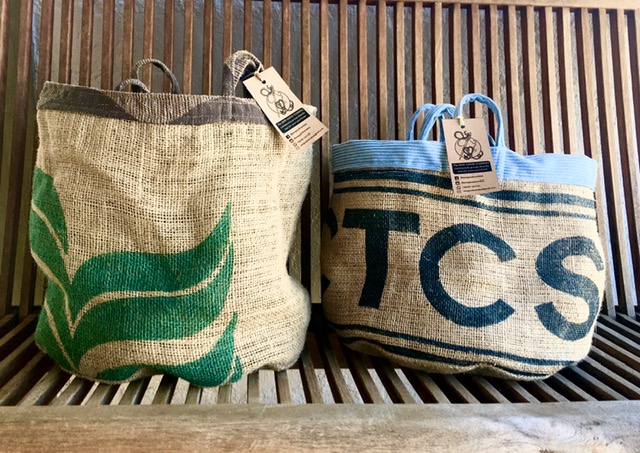
We now receive regular messages from companies keen to supply us with unwanted materials that we can turn into new product lines – such as these burlap (jute) coffee-bean sacks that Amory fashions into sets of plant-pot holders/storage containers (and which became a best seller overnight). Donating to projects such as ours doesn’t just solve a logistical problem for these businesses but burnishes their reputation as enterprises who get the ‘ecofriendly’ message and want to support the local-is-lekker philosophy.

I am now looking for a new project that can utilise more of the unwanted waste that comes my way now that Sew Good Namibia has finally hit its post-Covid stride and generates income month in, month out for its craftswomen. One idea is to train people who are ending a custodial sentence to make small picture frames from wooden offcuts discarded by framing businesses. And I still want to link up hotels and accommodation establishments with a home industry group that can upcycle guest soaps – as has been done successfully elsewhere.

There’s a long way still to go. Namibian consumers are ready to embrace a greener lifestyle it seems but often they are faced with choices that are a compromise at best. I no longer bore people senseless talking endlessly about the scourge of plastic waste and similar issues (although the threat of climate change is one that still only really reaches one sector of the community apparently). Pointing out that buying an imported cotton or paper bag is not truly a viable alternative to a single-use plastic bag, or that industries that claim to recycle old clothes are often guilty of greenwashing, can be tricky if someone is genuinely trying to commit to changing their purchasing habits and you don’t want to demoralise them with buzzkill

But the message is here, and it’s here to stay. I no longer believe that people are just shrugging and ignoring the small steps they can take to halt Earth’s destruction, nor are they suffering from eco-fatigue. The burgeoning green ethos is captured so beautifully in a quote I am seeing more and more online: Start where you are. Use what you have. Do what you can.

(2026 update: the egregious and indiscriminate use of AI-generated images by just about everybody online now is making me re-think whether people really want to absorb the message that all those cute (fake) animals allegedly filmed bouncing around on garden trampolines at night are the result of processes that are contributing to environmental destruction…)

Playing catch-up

It can very often feel as if my adopted country fell off the map when the rest of the world started using the Internet for basic transactions, research, entertainment and social communications. Many bills still arrive by mail in a post office box (or did before the pandemic) and – with huge swathes of the country still un-electrified – using wi-fi at home remains a privilege reserved for the wealthier residents of bigger towns.

Add to that the fact that local competitors to Amazon have never been able to make inroads when packages cannot be guaranteed to arrive safely at a post office, nor is it possible to deliver during working hours to an unoccupied house given that tall palisades, electric fences, remote-access gates and large dogs tend to guard even modest homes and whole suburbs can be devoid of street signs – well, a physical trip to the shops or open market remains how most of us still get all our goods.

Coronavirus changed all that. We only experienced one full-scale national lockdown but with international supermarket chains sourcing nearly all of their products from overseas and cross-border transportation completely halted, suddenly the whole country was looking for new ways to access even staple products. And identifying and buying locally manufactured or home-grown goods suddenly became a necessity, not a novel experiment.

A veritable deluge of Namibian online shopping sites offering a ‘local-is-lekker’ consumer experience emerged, as it seemed, overnight. But good intentions didn’t get them very far when minimal thought or expertise went into their design and most fell away just as quickly as they had sprung up.

Sew Good Namibia now utilises an online marketplace platform called ‘Padstal Namibia‘, set up (full disclosure) by my daughter, daughter-in-law, and a friend. They put many, many hours of work into conceptualising the platform and ‘test driving’ it before full roll out. Therefore many of the glitches that sabotaged their less-professional competitors were ironed out before Padstal Namibia started to accept uploaded products from vendors and open for business.

A padstal was originally a roadside farm stand selling all manner of local produce and handicrafts and indeed there used to be similar shops in the malls when I first came here in 1998. The new, 21st-century iteration allows consumers at home to place orders online and have them delivered in Windhoek and the surrounding areas – a real boon when we were all sheltering in place. It also, of course, provides the sort of free exposure and retail support that micro-scale enterprises like ‘Sew Good Namibia’ would not be able to finance on their own.

Marketing ‘Sew Good Namibia’ products with an online shopping platform gives customers a much better opportunity to view and compare products than we can achieve by posting them on Facebook and Instagram.

It does very much seem as if shoppers are still getting used to the idea… and it will take a while before we urbanites all abandon our habit of the weekly shop in crowded and expensive stores. But for ‘Sew Good Namibia’ – and other home-based industries we have been able to introduce to the concept – online shopping has allowed us to reach a much bigger pool of potential clients, who will be able to place automated orders once the economy picks up and people are once again looking to browse and buy non-essential items such as those made by our craftswomen.

(2026 update: customer numbers never really reached viable volumes for ‘Padstal Namibia’, nor for the huge number of similar online shopping sites attempting to service Namibian consumers during the pandemic. When you consider that our pharmacies have always provided a home delivery service via motorbike couriers, there must be limiting factors – such as the need to deliver perishable foodstuffs quickly – that prevented these sites from achieving success. Of course, Amazon doesn’t have a Namibian platform and has struggled to establish a foothold in South Africa so the logistical challenges must be complex and considerable.)

Green shoots in tough times

The rain has blessed Namibia as it hasn’t done in a decade. The dams are full, the antelope families are fat, the trees are full of birds’ nests. There are even lakes in the desert… but although we are all just plain relieved to be free of the drought conditions that have prevailed for far too many years, the absence of the visitors that would bring a much-needed boost to the economy is a sobering reminder that the rest of the world is still stuck in the terrible suspended animation of Covid-19, 12 months old now.

Our statistics with regard to the medical impacts of the pandemic show that we have been the lucky ones so far, relatively speaking (2026 update: this wasn’t to last, unfortunately). But the economy was already in extremis before 2020 and the figures for businesses shuttered and people retrenched as coronavirus delivered the coup de grâce are far less salutary.

Many consumers, here and worldwide, pivoted towards purchasing locally sourced products last year – by force of circumstance as borders closed to imports, yet also by choice. But the ‘Good for Namibia’ initiative that was already established – the ‘Sew Good Namibia‘ project – as well as others that were ready to launch have been victims of the diminishing purchasing power of the nation as every household found itself affected, in one way or another, by the need to scrimp and save for the long haul. The income from the sewing work is still enough to make a difference for the craftswomen of the co-operative, and we have even taken on another producer recently, but our sales have inevitably plateaued.

I continue to admire and celebrate the young Namibians (and a few not-so-young!) who are flexing their entrepreneurial muscles and adapting their business models to the straitened times. As well as those that are moving towards, and embracing, the concept of sustainable use of our precious resources. You only have to spend half an hour on Instagram to see that their hustle is being rewarded.

The creative women of ‘Sew Good Namibia’ continue to explore new ideas while waiting for our old markets to revivify. I am still hopeful that at some point too, when hotels begin filling up again, I can launch a long-incubating recycled soap enterprise: ‘Good and Clean’. Namibia is officially ‘open’ (if you can just jump through a million bureaucratic hoops!) and we look forwards to the time in the not-to-distant future when we can share the bounteous year that nature has gifted us with our international tourist friends, too.

Lightweight safari scarves, each one unique, made by Julia Gomachas of ‘Sew Good Namibia’ from upcycled luxury embroidered and sheer fabrics

Kindness is the new currency

We all have our own individual takes on how reality has changed since we became aware of Covid-19, wherever we are in the world. The first commercial flight in many weeks arrived in Windhoek a few days ago and with it, one assumes, the first overseas mail in a long while.

My very out-of-date ‘New Yorker’ magazine from earlier this year duly arrived in my post box and it reads, honestly, like a communication from another planet. Even those few short months ago, the pandemic was still a semi-abstract concept for people here in Namibia. In the US city where it’s published, however, the writers and photographers covering the unfolding crisis for the magazine back in May were clearly aware that, to use that overworked word, they were dealing with an unprecedented catastrophe… And yet, with the gift of hindsight, their words and images seem – now – to be wholly inadequate to the task of warning readers what might still be to come.

But over the past few weeks, as the infection rate has risen here at home and the government has responded with what seems to me to be pragmatic, consistent and effective leadership, it’s also been possible to see how – to use another cliche – the worst of times has brought out the best in people. And I’ve been truly humbled by the numbers of perfect strangers reaching out to the Sew Good Namibia project specifically, and local producers and traders more generally, in an effort to assist in ways that uplift the most hard-hit and impoverished communities. Together we are forging connections that will endure and bolster the circular economy – whereby goods are exchanged and repurposed, rather than discarded and replaced anew – after the dark days are a receding memory.

In the ‘All Trousers’ page of this blog you will soon find the details of the businesses that have generously supplied us with donated fabric and other resources so that the craftswomen can continue to keep creating the bags and other items that help to support their families. However, I couldn’t resist including here a photo of the FIVE big boxes of large burlap (jute) coffee-bean sacks delivered to Windhoek from the coast, for free, courtesy of Two Beards Coffee and Formula Courier Services. Their selfless determination to see us supplied with a new type of material for upcycling so that we can add to the range of products we offer is just one example of the generosity flowing freely between Namibians right across country.

Green is in ‘Vogue’

Magazines are ‘stuck on the truck’ currently, as we say here in Namibia – a nation that is compelled to source so many of its consumer goods from South Africa and where, at the time of writing, the flow of cross-border imports has pretty much ceased completely. The copy of British ‘Vogue’ I recently picked up off a very empty shelf at the store (my guilty-pleasure luxury in these trying times) was an issue from way back in April this year so it represented a sort of distorted lens through which to view the recent, pre-Covid past.

With a (fairly new, fairly young) Editor-in-Chief in Edward Enninful OBE, and refreshing insights into the future of the fashion industry, I wasn’t surprised to see that the publication has created a new role, that of Contributing Sustainability Editor, in order to focus on the ways in which designers and manufacturers will be meeting the challenge of waste in a world growing increasingly conscious of the costs of instant-gratification consumerism.

The ‘Sew Good Namibia’ project recently received an amazing donation of new, high-quality hunters’ camouflage clothing, which was the starting point for the creation of this one-off shopping bag.

This growing global awareness has repercussions for all producers – large and small, industrial and artisanal – who work with fabric, as people begin to reject the purchase of throwaway items of ‘fast fashion’ clothing (and other such goods) meant to be discarded after one season (or even one use!)

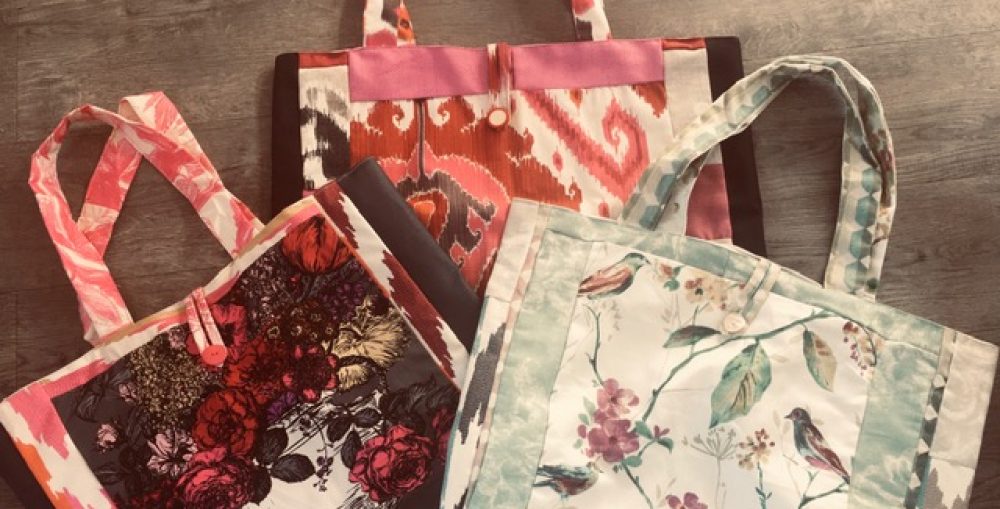
The Namibian craftswomen of ‘Sew Good Namibia‘ are increasingly turning their hands to commissioned items that embrace this ethos. When we started out, we just used donated luxury furnishing fabric to make simple, upcycled patchwork shopping bags – intended to replace single-use plastic ones. Now, Amory and Julia, who head the project, are imagining and producing a much wider range of stylish items, including ones that use the tiniest scraps of pleather – cellphone covers, for example – as well as others that would not look out of place in an upmarket home-furnishing store.

This has led me to think about how we can conceptualise, and capture in a meaningful phrase, what we do as we progress to selling unique products online for specific customers. It’s also clear that we need to make a wider range of goods for ‘small money’ for events such as the Finkenstein Bush Market, so that younger customers can purchase our items and cash-strapped locals can still treat themselves to something sustainably-made and truly lovely.

“BUY it because it’s beautiful

VALUE it because it’s eco-friendly

CHERISH it because it uplifts Namibian families”

The quiet retail revolution

I sometimes think that Namibia, my home for more than two decades, suffers from ‘littlest sibling’ syndrome. We look to other – bigger, richer, more ‘developed’ – countries and try to emulate them in a search for economic success, without really questioning whether we have enough in common to follow in their footsteps (or whether it’s advisable to even attempt to do so, given our limited human and natural resources).

Furthermore, we seem to think that anything transported to us from overseas just has to be better than the things we can make or grow at home. Indeed, there’s a certain cachet attached to the descriptor ‘imported’ when added to certain goods despite the price, in environmental as well as cash terms, of bringing in so many items from elsewhere – specifically from our ‘big brother’ South Africa – when we could in theory begin to make them here at home.

Every year we churn out a huge cohort of IT graduates – because adopting new technologies is deemed the shortcut to the industrialised nation we aspire to be – yet it remains pretty much impossible to do anything online apart from the most basic transactions; the platforms big business contracts to use for simple tasks such as filling in a form or tracking a parcel are simply unfit for purpose. (Indeed, satisfactory Internet coverage remains just a fantasy when so many parts of the country don’t even have electricity of course.)

At the time of writing, most of the country is now returning to some kind of post-Covid normality, with a couple of welcome new developments that I am happy to see take root in terms of retail activities. (2026 update: this turned out to not be the case, regrettably, and by the middle of 2021 things had taken a dramatic turn for the worse.) The first is that people have been compelled to buy local products as the cross-border trucking industry ground to a halt and this can only be good at grassroots level for an economy that was in dire straits even before coronavirus hit. One international pharmacy chain was cynically selling small boxes of imported single-use face masks at the exact same (grossly inflated) price as the one-off emergency income grant that our poorest citizens could apply for and it was gratifying to see people eschew these for much more economical fabric ones sewn at home by groups such as ‘Sew Good Namibia‘.

The community where I live – 3 housing developments situated in farmland just outside of Windhoek – initiated a marketplace in the bush one Saturday in June (literally, see the ‘Sew Good’ stall, below) where local producers could showcase their wares once the social-distancing measures were lifted somewhat. Many vendors who had made farm produce, condiments, bread or other baked goods sold out of stock entirely, emphasising the need for the type of locavore consumer mentality that’s been the norm in places like New York for a long time. ‘Sew Good Namibia’ sold many smaller items – people are essentially broke here and were not spending on big-ticket items generally – but also made lots of connections to potential clients that are proving fruitful subsequently.

The ‘Finkenstein Bush Market’ was so successful that it is set to be a regular event that will enable community members and the wider public to socialise and shop in ways that had not been possible before, when many folks would just drive to the supermarket to re-stock their grocery shelves or hit the mall for a range of products that are not eco-friendly and do not contribute towards Namibian livelihoods.

Another, linked, effect of the Covid-19 crisis was that young Namibian entrepreneurs set about creating markets for their goods through platforms such as Instagram with, I’m told by one such craftsman, great success. People who wanted to source locally made items were suddenly inspired to link up with manufacturers whom they would probably not have been aware of even a few months ago, through the power of social media. These emerging businesses have neither warehousing, offices, inventory nor overheads – apart from the price of a data bundle – and they simply take orders from customers who have seen photos of their handiwork online and offer hassle-free delivery as part of the service. Word of mouth and positive recommendations are the tools they deploy to grown their client base and their income.Good for them, and good for Namibia, of course!

Certainly, a year after ‘Sew Good Namibia’ was launched, we have some lessons to absorb from these smartphone entrepreneurs and this week saw the (tentative) launch of our own Instagram account where a different group of potential customers can view and choose products that can then be delivered for free in town. As we take more orders and expand, this is going to be more effective than dealing with individuals via WhatsApp or Facebook.

We have all realised a lot over the past few months in terms of the value of small-scale but personalised retail experiences. Plus, the feel-good factor that arises from getting to know neighbours (in a conducive but decidedly low-tech environment in the case of the Bush Market) and supporting local businesses cannot be over-estimated. It took a crisis to get us all in touch with what really matters – spending time with real (socially distanced) people, in real life – and I hope that the connections we have made, and will continue to foster, will prove to be long-lasting and productive ones.

There were ‘cat people’ at the inaugural Finkenstein Bush Market in June 2020 and this shopping bag design certainly grabbed their attention and made it our most ‘in demand’ new product.

Smaller is stronger

This blog has been inactive for a while now and with good reason. Although we have been ‘quarantined’ from most of the terrible effects of the coronavirus pandemic here in Namibia to a large degree, one thing we haven’t been spared is the toxic tsunami of ignorant or mischievous commentary, some of it point-blank lethal, that’s overtaken the Internet. I’d no desire to add to this pointless accumulation of speculation and anecdata and preferred to keep schtum until I had something useful and fact-based to say. Vent over…

My belief – admittedly an unpopular one in many Namibian quarters – is that the CDC and the Government of the Republic of Namibia have exhibited admirable leadership in reacting hard and fast to the threat of Covid-19. I’m very happy to acknowledge that here and express my personal thanks. It has been a really, really tough time at the household level for many disadvantaged citizens, not to mention ethical business people struggling to make ‘best worst’ decisions that will allow their operations to remain afloat. But no one has died from the virus to date – I really think that’s worth emphasising – and no one will die from the longer-term consequences of the business shutdown if we take a moment to look at how our economy needs to be diversified and localised.

The day it was announced that Namibians would have to wear face masks in public, a veritable army of home-producers swung into action, including the women of the ‘Sew Good Namibia‘ project. Not to be snarky but I hope that the international pharmacy chains charging exorbitant prices for environmentally unfriendly disposable masks took a massive hit as people took up the challenge of ‘local is lekker’ and began manufacturing simple but effective, reusable fabric alternatives. Local companies have also developed their own disinfectant sprays using ‘recipes’ they researched online.

As restrictions are eased, I’m optimistic that the national sense of community engendered by the crisis will not turn out to have just been a temporary blip, but will translate into a desire to resuscitate the economy in every way we can… and certainly this should mean that, wherever possible, people support local producers rather than pivoting back to the default setting of purchasing goods (especially ones with sketchy ‘green’ credentials) manufactured abroad, with all this means in terms of reducing the environmental damage caused by long-haul transportation.

The bags produced by the ‘Sew Good’ craftswomen just get more and more stunning

Of course, ‘Sew Good Namibia’ wasn’t able to distribute and sell its products during the lockdown, and our hopes of creating a sustainable market through sales to tourists were set back somewhat. Nevertheless, the ladies have certainly not been idle and we are accumulating shopping bags and tote bags for sale once circumstances allow.

(2026 update: unfortunately, the final national statistics for Covid-19 proved to be appalling. Cases started to increase in November/December 2020 and shot up dramatically in June/July 2021. The effects were devastating: firstly, great many businesses, especially those dependent on tourism, failed to weather the storm. Furthermore, almost every Namibian I know lost at least one member of their extended family and the final death toll was in excess of 4,000 people – very high for such a small and scattered population.)

Souvenirs, self-catering, and scaling up

Before setting up a commercial endeavour, we’re told we need a business plan, a budget, a forecast – a bucketload of ‘wishful thinking’, truth be told, when you’re trying to enter the market in a recession and with a product that’s untried and untested. For the upcycling projects under the ‘Good for Namibia’ banner, this means that business development out in the real world is likely to be a far more organic process (if you will pardon the pun).

As Amory, Julia and I have discovered with the pilot enterprise, ‘Sew Good Namibia‘, some of our objectives and plans have fallen away as others have emerged to take their place. Certainly, my initial idea to market items and take orders online hasn’t taken off: Namibia, it seems, isn’t ready to purchase products without seeing them. And environmentally conscious locals already have their own reusable shopping bags, often purchased overseas, so they’re not ready to buy more (albeit they report never remembering to take their existing ones out of the car when they visit the store!)

The latest stats show a small but steady growth in visitors coming to Namibia over the past decade and so these folk represent the group of consumers we are aiming to reach in 2020, while we continue to meet the needs of locals who are growing increasingly aware of ‘green living’ choices, of course. We’re therefore very happy that speculative emails recently sent to a few Windhoek B&B and self-catering accommodation establishments have resulted in some interest from managers who wish to offer our patchwork bags to visitors who will be looking for locally made souvenirs and reusable bags for shopping in town or travelling around the country – especially important since the ban on single-use plastic bags in national parks came into force.

Lined tote bags made by the ‘Sew Good’ project specifically for the tourism market. Thanks to all at Rivendell Guest House for agreeing to stock this first consignment.

A big ‘Thanks!’, therefore, to Erika at the Rivendell Guest House who liaised with the owners and arranged to place some of our bags on consignment, the such first tourism-accommodation establishment to do so. We hope that as the tourism season begins we will be able to deliver regular volumes for them to sell on our behalf; backpacker lodges and similar places have also expressed an interest in showcasing similar items. This is probably a more realistic way to sell the bags than renting a stall at the regular markets (which mostly cater to locals), especially as the hardworking women of the project simply don’t have time to attend to a stand over the weekend when they work all week already.

(2026 update: just as our plans to stock B&Bs, guest houses and similar establishments were gaining some traction, the Covid-19 pandemic began to have a disastrous effect on Namibian tourism businesses. Like many other places, Rivendell Guest House had to close down operations temporarily, and then cease operations entirely.)